Français
English
Español
Italiano
Portugués
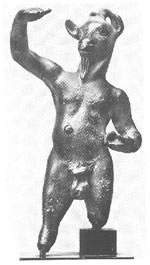
Bronze figure of Pan, 5th century BC. This is the figure used in Pantheatre's logo. Pan, the shepard, here with a goat's head, is watching afar, and holds a whip in his left hand. Berlin Museum.
Figurine en bronze du dieu Pan, 5e siècle av JC. Cette statuette est celle utilisée dans le logo de PANTHEATRE. Pan, le dieu berger, y est figuré avec une tête de chèvre; il regarde au loin et, dans la main gauche, tenait un fouet. Musée de Berlin
Estatuilla de bronce del dios Pan, del siglo quinto antes de Cristo. Esta estatua es la que se utiliza en el logo PANTHEATRE. Pan, el dios pastor, se representa aquí (no es usual) con una cabeza de cabra, que mira hacia el campo abierto. En su mano izquierda, sosteniendo un látigo. Museo Arqueológico de Berlín.
PAN |
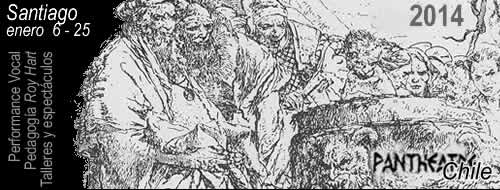 |
| Rúbrica Pantheatre Chile 2014 : detalle de uno de los grabados de la serie Caprichos de Giovanni Battista TIEPOLO UNA EXPLICACION por Enrique Pardo | |
Rubrique Pantheatre Chile 2014 : détail d'une gravure de la série Caprices de Giovanni Battista TIEPOLO UNE EXPLICATION par Enrique Pardo. |
|
| Pantheatre Chile 2014 rubric: detail from one of the engravings of the Capricci series by Giovanni Battista TIEPOLO AN EXPLANATION by Enrique Pardo |
Le dieu patron de Panthéâtre, aux pieds de chèvre et aux deux cornes, fut métamorphosé par le Christianisme en son ennemi juré, le Diable, le Mal, parce qu'il incarnait la sexualité. Hérodote rapporte que ce fut l’offre d'aide de Pan qui décida les généraux athéniens à «combattre la plus célèbre et défavorable bataille frontale de l'histoire de l'Antiquité. "Ils furent les vainqueurs en septembre 490 AC à Marathon. Charles Boer, à bien des égards le parrain du Festival Mythe et Théâtre, a écrit un superbe article dans Spring Journal # 59 sur le dilemme que cette épiphanie pose aux théologiens et aux historiens. (Voir Spring Journal). (Extrait de la brochure du Festival Mythe et Théâtre 1997 dédié à "L'Ennemi".)
Dieu-bouc panique, fils d'Hermès, les bergers de son Arcadie natale fouettaient ses statues les années de mauvaises récoltes, (ils fouettaient et jettaient des tomates pourries sur son demi-frère, Priape!). La légende dit que Pan est mort en 33 après JC... Depuis, il a souvent été vu comme le grand bouc malin de la sorcellerie et de la magie noire. (Extrait de la brochure du Festival Mythe et Théâtre 1995 dédié à "La Magie".)
Pan, apparemment, a fait rire TOUS les Dieux et les Déesses lorsqu’Hermès, son papa, l'a amené en Olympe. Sa mère a pris la fuite quand elle le vit pour la première fois - ses pieds, ses cornes et sa barbe de bouc. Cela n’a pas fait rire le Christianisme : il est devenu son Malin. Une divinité borderline (ne le sont-ils pas tous ?), Pan est le chanteur-danseur (d’où Panthéâtre) - hanté par le désir et par l'imagination. (Extrait de la brochure du Festival Mythe et Théâtre 2000 dédié à "Commérage".)
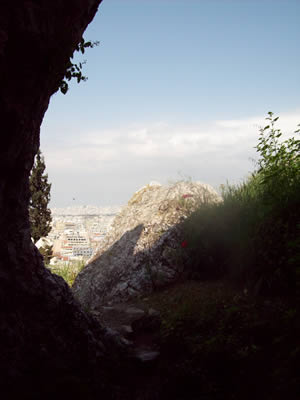
Voir photos dessous: en échange de son aide à Marathon,
Pan demanda qu'on lui offre un culte à l' Acropole.
The patron God of Pantheatre, with the goat feet and the two horns, was metamorphosed by Christianity into its arch-enemy, the Devil, Evil, because he personified sexuality. Herodotus reports that it was Pan's offer of help that decided the Athenian generals to "fight the most famous head-on, odds-against battle of ancient history." They won at Marathon in September 490 BC. Charles Boer, in many respects the 'Godfather' of the Festival, has written a superb article in Spring Journal #59 on the dilemma this epiphany poses to theologians and historians. (check Spring Journal). (From "The Enemy" brochure, 1997)
See photos below: in exchange for his help at Marathon,
Pan asked to have a worship cave at the Acropolis.
Panic goat-god, son of Hermes; the shepards of his native Arcadia used to whip his statues on bad years, (his half-brother Priapus would have rotten tomatoes thrown at him!). Legend has it that he died in 33 AD... Since then, many have seen him as the he-goat of witchcraft and black magic. (From the "Magic" brochure, 1995)
Pan, supposedly, made ALL the Gods and Goddesses laugh when Hermes, his daddy, brought him to Olympus. His mother fled when she first saw him - his horns, beard and goat feet.. Christianity did not laugh: he became its Evil One. A borderline divinity (aren't they all?), Pan is the singer-dancer (hence Pantheatre) - haunted by desire and imagination. (From the "On Gossip" brochure, 2000)
El dios patrón de Pantheatre, con los pies de cabra y los dos cuernos, fue transformado por el cristianismo en su archi-enemigo, el diablo, el Mal, porque él personifica la sexualidad. Herodoto nos informa que fue la oferta de ayuda de Pan que convenció a los generales atenienses a “luchar la batalla frontal más famosa de la antigüedad, con todas las probabilidades en contra.” Ganaron en la batalla de Maratón en septiembre de 490 AC. Charles Boer, en muchos aspectos, el 'padrino' del Festival, ha escrito un gran artículo en la revista Spring # 59 sobre el dilema que esta epifanía plantea a teólogos e historiadores. (Ver Spring Journal). (Cita del folleto del Festival Mito y Teatro 1997 sobre “El Enemigo”.)
Ver fotos debajo: a cambio de su ayuda en Maratón, Pan pidió tener una cueva para su culto en la Acrópolis de Atenas.
Pan, dios-cabra del pánico, hijo de Hermes; los pastores de su Arcadia nativa solían azotar sus estatuas en malos años, (a su medio hermano Príapo le tiraban tomates podridos!) . La leyenda dice que murió en el año 33 AD… Desde entonces, muchos lo han visto como el macho cabrío de la brujería y de la magia negra. (Cita del folleto del Festival Mito y Teatro 1995 sobre “Magia”.)
Pan, supuestamente, hizo reir a TODOS los dioses y diosas cuando Hermes, su padre, lo presentó al Olimpo. Su madre huyó al verlo nacer - ¡con cuernos, barba y patas de cabra! El cristianismo no se rió: lo convirtió en el Maligno. Una divinidad borderline (¿no lo son todos los dioses?), Pan es el cantante bailarín (de ahí Pantheatre) - obsesionado por el deseo/lujuria y la imaginación. (Cita del folleto del Festival Mito y Teatro 2000 sobre “Chisme”.)
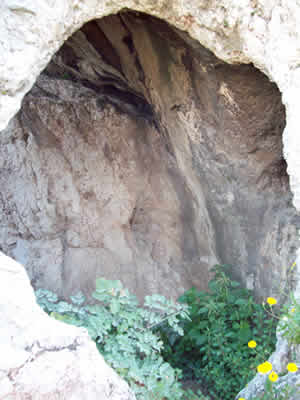 |
Pan's cave below the Acropolis in Athens. La caverne de Pan à l'Acropole d'Athènes. La caverna de Pan en la Acropolis de Atenas. Photos : Catherine Rogers
|
 |
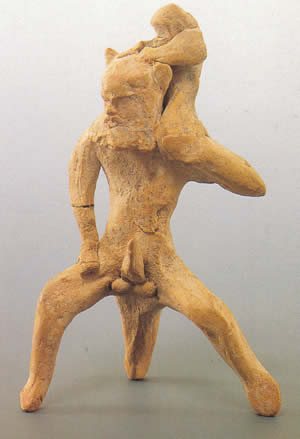 |
Statuette du dieu Pan, statuette primitive et géométrique, dont j'ai aimé la symétrie et le bizarre quand j'ai visité le Musée des Cyclades à Athènes. Agnès Dumouchel. |
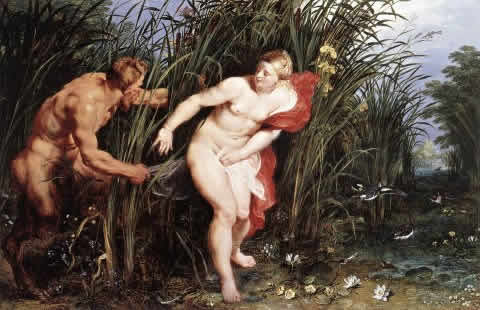
'Quanto mais inocente e ingênua for a consciência -Ninfa, mais violento e brutal será o ataque de Pan. O estupro de Pan é uma transposição de limites, mudança de registros, ruptura da ilusão de que a vida psíquica possa ser vivida "apenas" na fantasia e reflexão, atravessamento da Albedo rumo ao Rubedo, elogio da concretude como forma de fazer alma. Somos todos, sempre e ao mesmo tempo, Pan e Ninfa nos campos e grutas da vida inconsciente'
Marcus Quintaes |
||
|
||||